
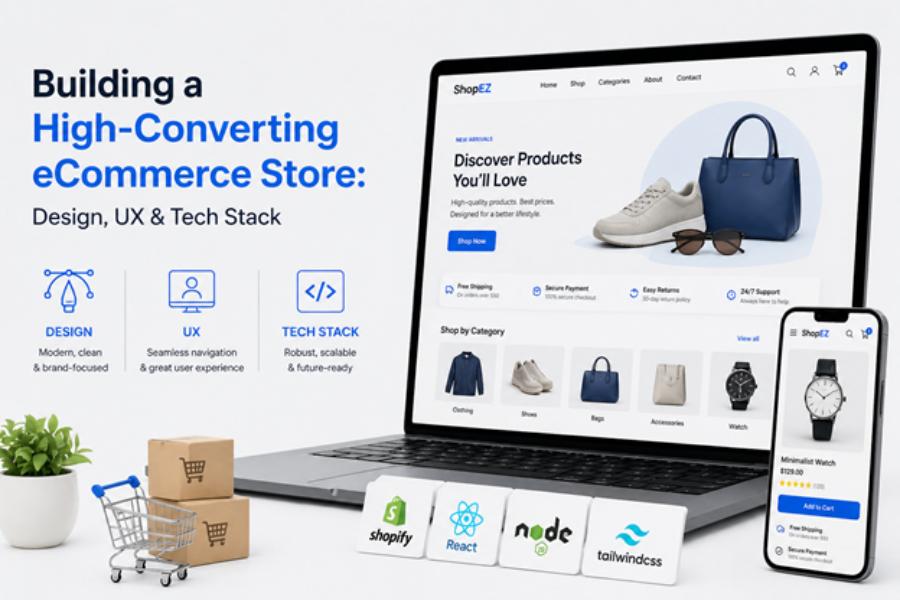
The eCommerce industry is growing at an incredible rate, with estimates of trillions of dollars in online sales by 2026 and beyond. Whether you’re a business in a new market or an existing one, now is the time for brands to build or grow their eCommerce stores.
The biggest challenge for business owners is setting up shop online. But that’s not where the challenge lies. But the hard part is converting visitors into customers and retaining them. That requires more than just a beautiful e-commerce store. You need an appealing design, a seamless user experience and the right technical infrastructure. If you don’t have all these, your store will flop, no matter how good your product. So getting the eCommerce website development right is so important. It’s not enough to get your business online; you need to make it profitable.
Here we’ll look at the essential elements of building a conversion optimised eCommerce website in 2026: from your UX decisions for your product pages to the technology powering your back-end.
The Role of UX in eCommerce Conversions
For eCommerce businesses, UX is a second consideration – something that is dealt with after the site is built. However, UX is the key to conversions.
In fact, 88% of online users are less likely to return to a site that has a poor user experience. In a world where consumers have so many choices – both locally and globally – a complex website is not an option in today’s eCommerce environment.
Here’s what successful eCommerce stores do for UX:
Good navigation- Don’t make the user think. Categorisation, sorting, and sticky search bars can help get people the right product. Confusion leads to a higher bounce rate – even with a good product.
Easy checkout- The global average cart abandonment rate is over 70% of which a chunk can be attributed to complexities of the checkout – long process, hidden fees, required registration. The websites that have highest conversions have the most minimal checkout process, allow guest checkouts and prominently display trust factors (secure checkout badge, return policy) when the customer is about to abandon.
Small UX elements create trust- These minor details in user experience like the add-to-cart button “spinning”, the message that the product has been added to wishlist, or the error message in the form field indicate that the website is well designed and safe to use. In a world where brand trust is a critical component of retail success, these interactions matter.
UX testing is not optional- The best stores aren’t the stores that are built solely out of assumptions, but rather stores that are tested, heatmapped and A/B’d. UX iteration is what makes the difference between stores that stagnate and stores that have ever-improving conversion rates month to month.
Good UX is good UX. Customers don’t even see it — they just end up buying more than they normally would.
Design Principles That Drive Sales
When designing your eCommerce site, in addition to your UX, you also need to consider your customers’ design preferences.
Luxury over low price – Consumers want quality, not low price. Clean lines, high-resolution images and elegant colours are more indicative of luxury than crowded or “bargain” designs. Less is more and more is aspirational.
Mobile-first, not mobile-adapted – It’s important to understand the difference between designing for a desktop and then trying to cram it into a smaller screen, versus designing for mobile first. Conversion-focused stores are mobile-first – buttons are large, menus are easily accessed with a thumb, and checkouts are designed for one-handed operation.
Culturally savvy photos – Product shots, lifestyle shots and models need to resonate with your audience’s cultural values. Companies that use locally produced visual assets and thoughtful collage design elements have a huge advantage over those relying on generic stock photography.
Speed as a design element – Performance is design. All design elements – image formats, animations, how fonts are loaded – affect performance. In an industry where the expectation is that pages will load as fast as possible, fat designs just don’t convert.
The Right Tech Stack for High-Converting eCommerce
Good design is backed up by good tech. The underlying technology for your eCommerce store will not only impact how it looks and feels, but its speed, capacity and (more importantly) its ability to link to and from other systems.
1. Adobe Commerce– (formerly Magento) is the go-to eCommerce platform for enterprise and mid-sized retailers globally. It’s adaptability to work with complex product catalogues, multiple languages and currencies and to integrate with enterprise resource and customer relationship management systems is perfect for expansion. Businesses that choose to develop with Adobe Commerce have a complex and scalable platform. Scalability is essential for brands looking to expand to a local or global market.
2. Shopify Plus– is a very popular option for D2C brands looking for a fast-track to market and a managed service without the development expenses. It’s a good choice for fashion, beauty and lifestyle brands for its app store and headless commerce.
3. Headless Commerce– is fast becoming the go-to solution for brands seeking to have it all: the best of both worlds for design and back end. Headless splits the front end of the site from the back end of commerce, allowing the UX and design teams to focus on delivering the optimal experience – tailored for every line of type, button and interaction – while the back end takes care of stock, pricing and fulfillment.
When it comes to selecting a platform and architecture, companies should partner with an e-commerce development company that has knowledge of both the tech ecosystem and target audience. A leading eCommerce development company has a full range of design and development services available, including UX strategy, frontend design, platform configuration and implementation and post-launch support.
Why Your Market Demands a Thoughtful eCommerce Strategy
Understanding your specific market through web scraping is key before diving into design and technology decisions.
The majority of eCommerce transactions today originate from mobile devices, so your store must be mobile-first. Many markets are increasingly diverse, meaning your site may need to support multiple languages, regional layouts, and culturally relevant imagery simultaneously.
Add to this the growing demand for fast delivery, convenient payment options, and high-end branding — and you have a market that rewards quality and punishes the mediocre. Overlooking details like typography mistakes can quietly impact readability and user trust, especially in multilingual interfaces.
That’s why professional eCommerce website development — rather than DIY templates — is the key strategic decision that sets successful brands apart.
Must-Have Features for a High-Converting Store in 2026
In addition to design and technology, there are several conversion essentials regardless of market:
Integration with relevant payment gateways — Shoppers expect flexible payment solutions including Buy Now Pay Later options, digital wallets, and local payment methods in addition to traditional credit cards. E-wallets and alternative payment methods now account for a growing majority of online transactions in many regions.
Personalization and AI search — Consumers increasingly expect it. Smart product recommendation algorithms and AI-powered search with intent tracking drives higher average order value and stronger engagement.
Performance optimization — Core Web Vitals scores directly impact both search rankings and user experience. In 2026, a slow store is an invisible store. Every eCommerce build should include performance auditing as part of the development process.
Bringing It All Together
When designing for conversion in 2016, there’s not one decision, it’s many: the user experience that eliminates any potential points of friction, the design system that gives a store that look and feel of a high-end product to a discerning customer, the technology that can grow from 100 orders a day to 10,000 orders a day, and the developers who understand the relationship between these decisions.
All the eCommerce success stories in today’s highly competitive marketplace have one thing in common: they know that their eCommerce store is infrastructure, not a toy. They care about design, technology and, most importantly, working with eCommerce developers who bring creative and business acumen together to make the right decisions.